
CCTV REFERENCE
Analog Security Cameras
Analog CCTV cameras remain a practical and cost-effective option for many surveillance applications. They capture video and transmit it over coaxial cabling or compatible twisted-pair cabling such as Cat6 with video baluns, to a Digital Video Recorder (DVR), where footage is processed, recorded and stored for playback.
HOW IT WORKS
Simple, Proven CCTV Technology
An analog security camera captures video and sends the signal to a DVR, typically over coaxial cable or twisted-pair network cabling such as Cat6 using compatible video baluns. The DVR processes and records the video, stores the footage on its internal hard drive and provides access for live viewing and recorded playback.
Modern HD analog systems can provide significantly better image quality than older analog CCTV technology while still making use of existing cabling infrastructure, including coaxial cable or compatible twisted-pair cabling such as Cat6 with video baluns.
Camera
Captures video at the surveillance location.
Video Cabling
Carries the camera’s video signal to the DVR using coaxial cable or twisted-pair cabling with compatible video baluns.
DVR Recording
Processes, records and stores footage for viewing and playback.
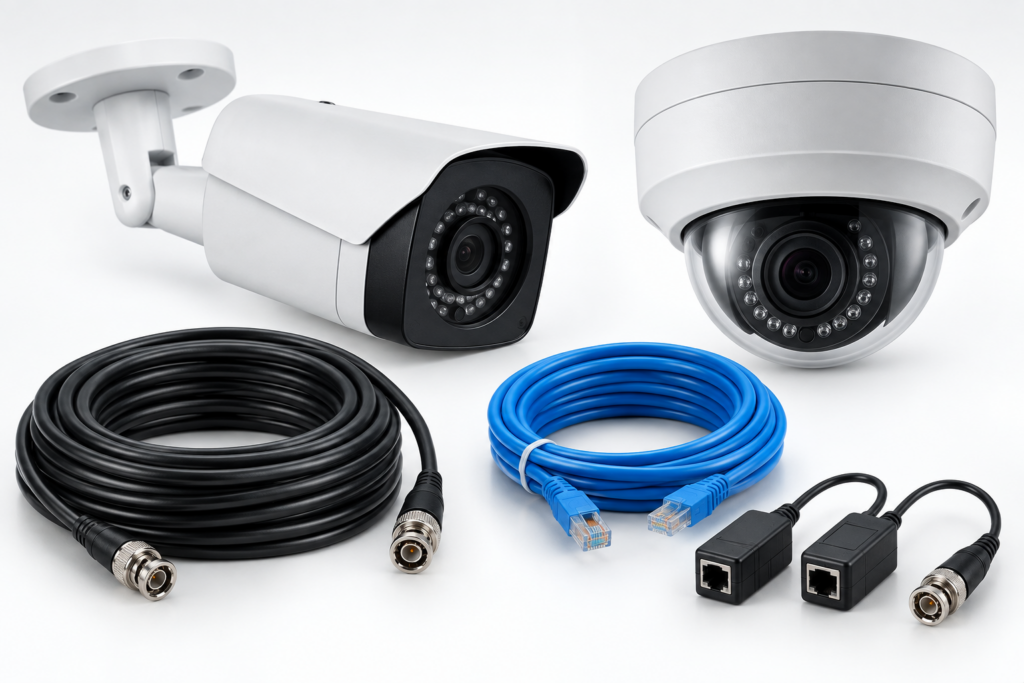
ANALOG CCTV
Where Analog Cameras Make Sense
Analog CCTV can still be an excellent choice where simplicity, reliability and cost are important considerations, particularly when an existing property already has usable coaxial camera cabling.
Cost-Effective
Analog CCTV can provide an economical surveillance solution for many residential, commercial and small-business applications.
Existing Cabling
Properties with existing coaxial CCTV cabling may be able to upgrade cameras and recording equipment without completely replacing the cabling infrastructure.
Proven Technology
Straightforward architecture and established technology make analog systems relatively simple to install, operate and maintain.
HD Analog Options
Modern HD analog camera technologies can provide considerably better image quality than older traditional analog systems.
Things to Consider
For larger or more advanced installations, IP camera systems may offer greater scalability, higher resolutions and additional network-based features. The best choice depends on the property, existing infrastructure, surveillance requirements and available budget.
Looking for a Complete CCTV Solution?
Analog cameras are only one component of a complete surveillance system. Bulldog can design and install CCTV solutions based on your property’s coverage, recording and remote-viewing requirements.